


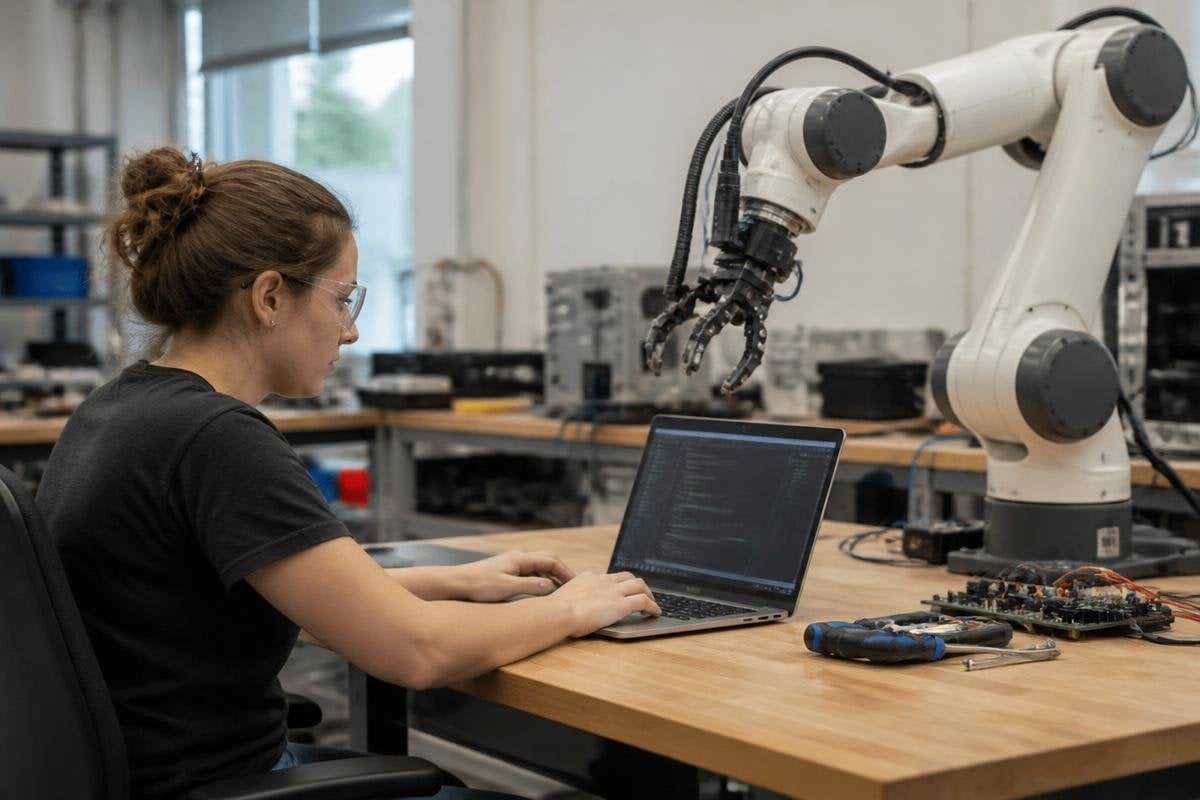
A robotics job can ask you to write code in the morning, tune a motor after lunch, and explain a safety fault before the shift ends. The most useful skills connect software, hardware, and the task the robot must complete.
Quick read
- Learn Python, C++, and ROS 2 for robot software
- Understand sensors, motors, calibration, and fault checks
- Build proof with a working project, test log, or code sample
Robot software comes first
Python helps with scripts, data checks, and early prototypes. C++ matters when a system needs fast control, sensor processing, or a ROS 2 node that runs inside a larger robot stack.
ROS 2 is the software layer that lets separate robot parts send data and commands. A useful worker can publish sensor data, read a topic, record a bag file, and find why one node stopped receiving messages.
Git belongs in this group. The team needs to know what changed, who changed it, and how to return to a working version. That skill matters when a new control setting causes a robot to miss its path on the factory floor.
The code also has to answer to the hardware. A person who can read a motor datasheet, check voltage and current, and trace a signal from a sensor to a controller can fix problems that pure software skills leave behind.
Sensors and motion need hands-on judgment
A robot only acts on the data its sensors give it. LiDAR measures distance with laser pulses, while cameras add visual detail. Inertial measurement units track motion through acceleration and rotation.
Each sensor can produce bad data when it is dirty, loose, poorly mounted, or badly timed. Calibration turns raw readings into useful measurements. That can mean setting a camera’s lens model, checking the angle between a LiDAR and the robot frame, or tuning an encoder so the arm knows where its joint sits.
Motion skills follow from there. You may need to set a joint limit, check torque, tune a PID controller, or change a robot’s path so it avoids a fixture. The work is practical: change one setting, run one test, record the result, then keep or reject the change.
Safety and systems thinking separate useful work from demos
A robot that moves well in a lab can still create risk near people. Learn how emergency stops, protective guards, speed limits, and safe restart procedures work. For industrial robot cells, ISO 10218 is a useful standard to know because it covers robot safety requirements.
Systems thinking means following the whole task. A picking arm may have good reach and accurate motion, yet fail because the gripper loses parts, the conveyor timing drifts, or the vision system sees a dark surface poorly.
This is where clear records matter. Write down the test setup, software version, payload, speed, fault code, and result. A short test log can tell the next technician more than a long claim about performance.
A fault code means little if the next person can’t explain what happened or what to try next. Reports at Robot24 give industry readers named machines and test details to compare with those records. Clear writing is part of technical work, because the next person may need to act on it.
Communication is a technical skill
Robotics work crosses job lines. A controls engineer may need to explain a timing fault to a technician. A technician may need to show a software team that the motor fault appears only after the gearbox warms up.
Clear communication means naming the condition and the evidence. “The arm fails after 20 cycles with a 2 kg load” gives a team something to test. “The arm is unreliable” does not.
I’d rank this skill above another narrow software tool because robot problems cross hardware and software boundaries. A person who can explain a fault clearly helps the team choose the next test instead of guessing.
A practical skills checklist
Use this list to choose your next project or training task:
- Build one ROS 2 project that reads a sensor and commands an actuator.
- Write a Python test script that records results in a CSV file.
- Read one motor and encoder datasheet and list the limits that affect motion.
- Run a calibration check with a known object or measured distance.
- Create a safety test log with the stop condition, setup, result, and software version.
- Explain one fault in plain language to someone who did not write the code.
A strong robotics career can start with one small system that works, fails in a known way, and leaves clear evidence behind. Choose a project with ROS 2, a sensor, an actuator, and a written test record; that combination shows what you can do when the robot has to work outside a slide deck.
